I was sitting with a group of people, some familiar and some unfamiliar, at my first-ever Thanksgiving in the U.S. As we went around sharing what we were grateful for, I took my sweet time. I am generally not a grateful person. I nag. I complain too much. I demand more from my life. God. The universe. Science. The power above us! Or in general, from me!
So I carefully phrased it and shared: “I am grateful for the opportunities I have now. For the woman I became because of those opportunities. The first woman in my family to set foot on U.S. soil. The first woman in my family to pursue a master’s abroad. The first woman in my family to cross oceans. And the first woman who’s expensive in all regards! Dreams, priorities, and choices! But I am also grateful for everything that led to this moment. Because I feel, ‘My grandparents walked, so my parents could run. My parents ran so that I could fly!’“
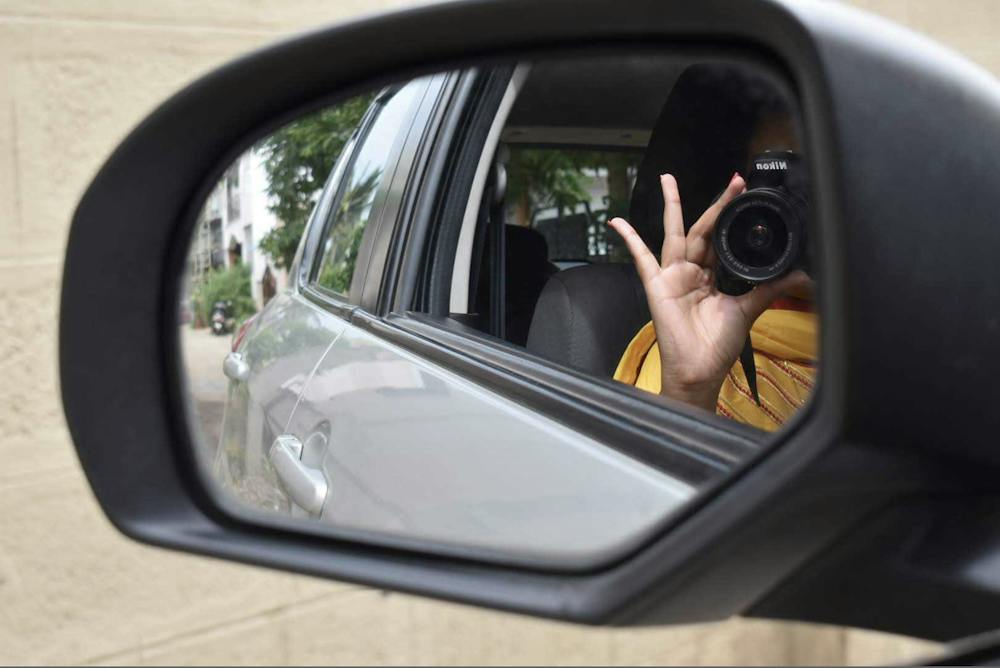
When I think about it now, my parents have not just run; they also drove. Atlas. TVS. Suzuki. Maruti. When I say “my parents,” I mostly attribute it to my father because he earned for my family, drove me to school and then bought a car and drove us around comfortably. As safe as it was, it was also equally restrictive. I could only get down at those stops my father made. And his stops were always on his terms: no parking, too tired, a U-turn he wouldn't bother with. Once, my mother and my younger sister wanted him to stop at a nursery to look at plants. He waved it off as if our wanting was already something he'd decided was foolish. He always had a narrative of us. What we needed, what we didn't, what was worth stopping for and what wasn't. And we, the women of our family, were supposed to live inside that narrative, because to him, that was protection. That was love. And because it was love, because we loved him back, we couldn't fight it. But love and misogyny, I've learned, are not mutually exclusive. Sometimes they ride in the same car.
My mother was a passenger princess. And she never complained about it. She was a homemaker. Still is. Do I disregard her? I wasn't sure. But subconsciously, I have felt I have judged her my whole life. That she wasn't the role model I aspired her to be. That she was neither the princess nor the queen. She was my mother and my father's wife. Why wasn't that enough for me?
As an adult and as a woman, I empathize with her now. If I were her, I would have made different choices. And if I were her friend, I would advise her to make different choices. She discontinued her education because her father asked her to, for marriage, for a household, for promises made on her behalf before she could make any of her own. She stayed with a man whose love, however real, came with conditions she never agreed to. She cared for a home, a mother-in-law and two daughters, and she quietly set aside the woman she might otherwise have become. These were not just choices. They were sacrifices, and the difference matters.
But unfortunately, I was her eldest daughter who held her captive in the dock of my judgment. I wished she would voice her anger more and speak her disappointment more loudly, because her silence sometimes felt like it suppressed mine, too. And when you can't find that voice at home, you look for it elsewhere. You find it in friends, in mentors, in oceans you cross alone. But none of it quite replaces what you lost back home.
What I forgot, for too long, was that she was quietly building the home I could leave. She got us, my sister and me, out, away from the joint family, into the city, into convent schools, into lives with options. And when relatives at family functions would needle us with that particular brand of cruelty — why aren't we working in the kitchen, why aren't we serving middle-aged men — she would answer not with apology, but with quiet pride. Educated girls. They'll do bigger things. Bigger than what the patriarchy expected us to do and be. Even her disappointment was a disguise for protection. I just wasn't paying attention.
What infuriates me is the question of where she ends and I begin. Am I just the sum of all the things she couldn't have for herself, her education, her voice, her choices? Is my life in some way hers, redirected? That thought unsettles me, because it makes me wonder if anything I've built is entirely my own.
And then comes the weight of it, because if I am the continuation of what she sacrificed, then I am also responsible. Every opportunity I hesitate on, every dream I talk myself out of, every time I play small, every time I take a detour, and every time I pursue something I want, is that a betrayal? Of her? Of the version of herself she folded quietly into me? I feel it most when I almost don't apply, almost don't go, almost don't try, and almost fight for my own desires. The almost is where her ghost lives.
But then I pull back further and ask the larger, lonelier question: Is this just what a life is? The total of what was handed down, expected, sacrificed and survived before you arrived? Is generational accountability just another name for the human condition, none of us ever fully free, all of us just carrying what came before us a little further down the road?
I don't have answers. But I feel all these questions in my body every single day.
Ugh! I sigh at the pressure!
When I question my worth as a woman, it always starts with the image of my mother in the passenger seat, letting a man drive her life. Why can't I perceive that image as love between two people — the very people who raised me to be this judgmental woman? Maybe because I was taught to look at the steering wheel and the driver's seat as the only parts that matter, while her quiet presence in the passenger seat was the cabin air that kept the rest of us breathing.
Is it possible that the very opportunities she sacrificed to give me are the same ones that make me look back at her life and find it lacking? That her greatest gift to me became the lens through which I failed to see her clearly?
Ugh! I sigh at the privilege!
She was never given the education, the language or the emotional space that duty never freed her to find. And yet she had her own wisdom: “Don't waste your words on people like that. There's no point. They'll either envy you or call it arrogance.” So, I never fought. I never confronted. I just built. That was her medium. That was her answer to every question she never got to ask out loud. And the woman underneath all the roles she was handed — the wife, the daughter-in-law, the mother — I like to believe she would have wanted me to ask them anyway. To ask them loudly, in the rooms she never got to enter.
I continue to carry her expectations: go further, don't settle, don't be a passenger in your own life. And yet I think she also carried a quieter wish that the world would be gentle enough that I wouldn't have to fight so hard, and that I let someone drive me around, out of love. I never sat in her passenger seat; I watched it from the back. But somehow that seat became the ceiling of my imagination. I learned to drive once. I didn't keep at it. I wonder now if that's a coincidence, or if I was always waiting for someone to take the wheel the way I watched someone take hers. Now that I reside 8,600 miles away from her, I carry her, her thoughts, her legacy and her pain in my heart and in my mind. God forbid, let it stop with me.
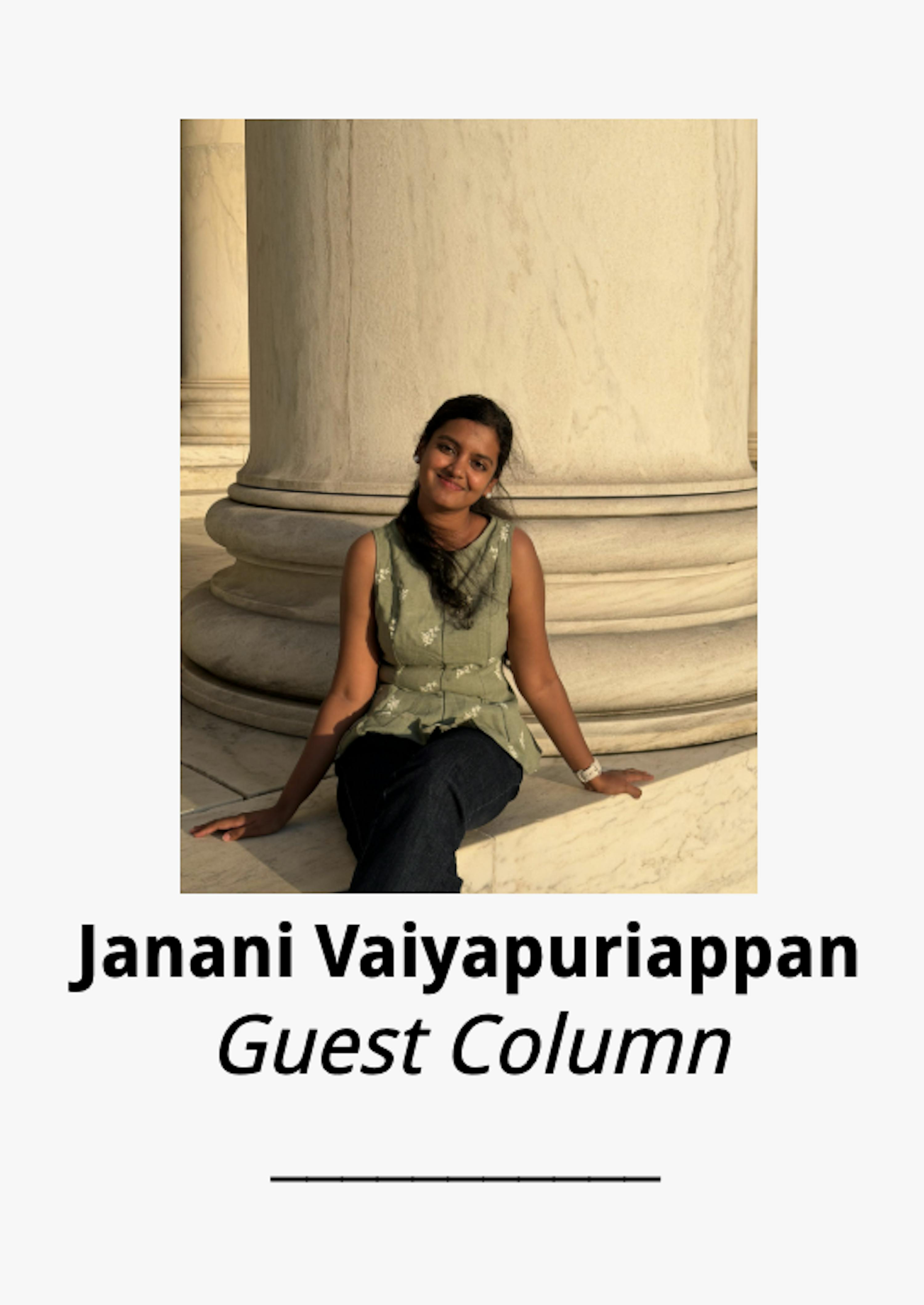
Janani Vaiyapuriappan is a second-year master’s student in Biomedical Engineering from India.