On Friday, September 11, the Aronson Center for International Studies hosted the first talk of their Fall 2026 speaker series. Ryan Calder, an associate professor in the Department of Sociology, hosted a talk titled “The Arab Gulf States, Global Energy Markets, and the 2026 U.S. Midterm Elections.”
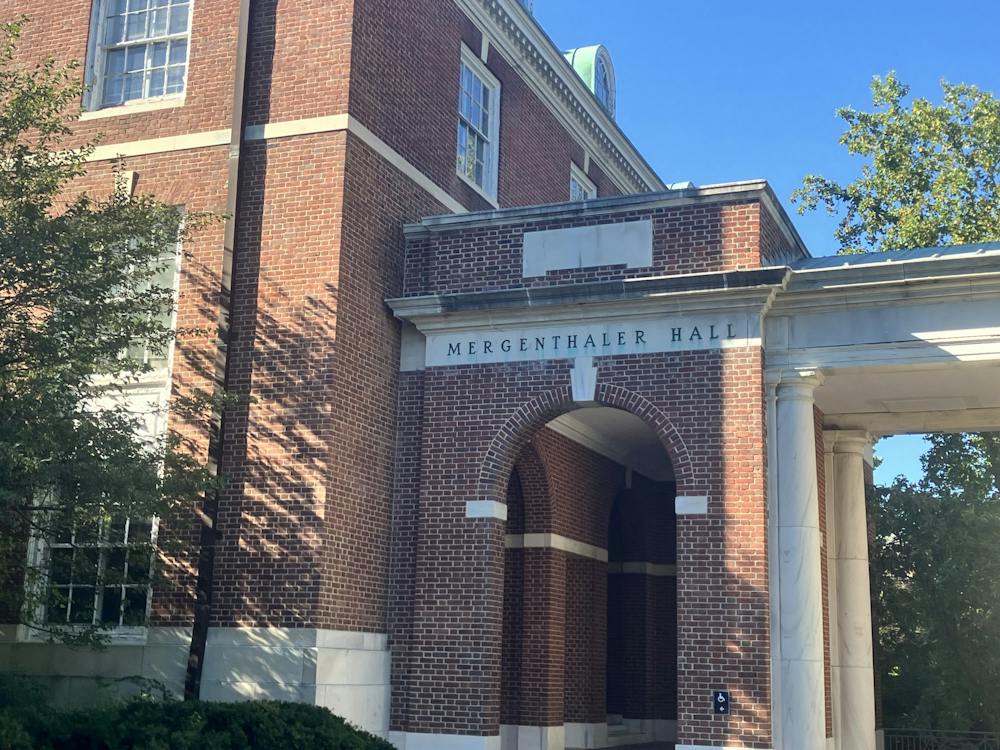
Much of Calder’s presentation dealt with the Gulf States — namely Saudi Arabia, the United Arab Emirates (UAE), Qatar, Bahrain, Kuwait and Oman — and their ever-changing relationship with the U.S., especially in the context of the upcoming November midterm elections. The talk also touched on the Iran war, as well as the global oil supply, and how these provide context on the U.S.’ increasingly complicated relations with the Gulf States. The presentation took place in Mergenthaler Hall and was well-attended by students both inside and outside of the International Studies department.
Calder introduced his presentation by highlighting the complex nature of U.S. relations with the Gulf States and how this impacts their hopes for the midterm elections.
“Things are changing very fast. It's certainly not a sort of situation where we can say, well, the Arab Gulf States are in favor of [Democrats] winning or Republicans winning, or something like that,” Calder said.
Calder specified that these six countries, all members of the Gulf Cooperation Council (GCC), differ somewhat in their foreign policy agendas and that the U.S. does not have equally strong relationships with every GCC member.
"The strongest relationships with the United States have been between Saudi Arabia and the UAE," Calder said. "Saudi Arabia [has] a very long historical relationship with the United States; you can go back to any president since the 1940s, since Roosevelt, and we see this strong relationship between the House of Saud, that is, the kings, the monarchy of Saudi Arabia, and the presidents, both Republican and Democratic in the United States.”
However, Calder did highlight one trend that can be noticed in the relations between the U.S. and all of the Gulf States: they have deteriorated since the start of the Iran war.
“If there's one sort of big picture conclusion, it is that the Iran War caused all of the GCC countries to lose faith in their relationship with the United States,” said Calder.
Calder also touched upon the relationships between the GCC countries themselves and how, in the past and currently, they have not always been positive.
“Another thing that has happened is a widening of the rift between GCC members. Some of you may remember some years ago, about eight years ago, there was a blockade of Qatar [enforced by other GCC states] particularly Saudi Arabia and the UAE and Kuwait, sort of against Qatar,” Calder said.
The blockade Calder referred to lasted from 2017 to 2021 and largely consisted of pressure from Saudi Arabia and other Gulf States as a result of Qatar’s sympathetic relationships with certain Islamist groups.
Calder closed out his talk by emphasizing that GCC members do not necessarily have a simplistic solution in mind when it comes to U.S. relations and the midterm elections.
“I think it's too simplistic to say [that] Trump is unpredictable. Trump's not on the ballot," Calder said. "Therefore, the GCC governments want the Democrats to win."
Calder went on to describe what specific goals the GCC members have in mind for the U.S. federal government as a whole.
"I do think that they would probably be happy with a checked president, a president that does not have a majority in Congress that allows him to do almost everything he wants," he said. "The ongoing war in Iran is terrible for them, with the exception of this brief window in June and July when there was a ceasefire that then quickly ended.”
After the presentation, Calder then yielded to questions from students and faculty in attendance on a range of topics from the military readiness of GCC countries to the Strait of Hormuz.