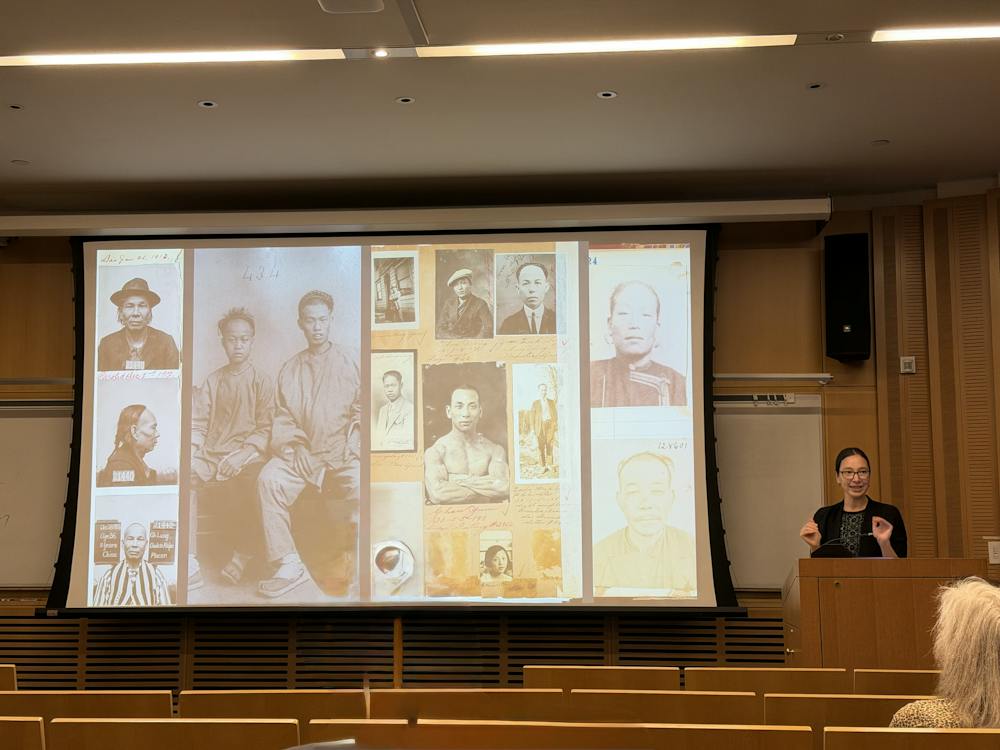
On Oct. 8, 2026 the History Department hosted Professor Beth Lew-Williams for this year’s Stulman Lecture, where she spoke about her book John Doe Chinaman and the history of Chinese racial discrimination in the U.S.
In an email to The News-Letter, the History Department explained its decision to invite Lew-Williams to speak about this topic.
“[Immigration] is a hot button political topic, and it has shaped American history in profound and abiding ways. It is a subject of interest to all kinds of students and scholars as well. We also have a new undergraduate track in Law and History. The History Department wanted to use the Stulman Lecture to shine a light on this vital topic and the importance of law in shaping immigration regimes,” the department wrote.
The event began with Lew-Williams contextualizing the word “Chinaman.” She explained that it was used to denote inferiority rather than overt racism.
“It was not sort of an aggressive racial slur [in the 19th century]... It had a weight to it. It conveyed a sense of inferiority, and it's really only over time that it became this more aggressive racial slur,” Lew-Williams said.
Lew-Williams also explained that the word “Chinaman” aligns with the anonymity of Chinese individuals in immigration records.
“[Americans] recorded 2,581 Chinese people, but only about two dozen of them had names. But everyone else is listed in this way, as a Chinaman,” Lew-Williams explained.
To research her book, Lew-Williams visited archives across California to investigate what Chinese people were permitted to do in U.S. society, how laws and government policies shaped their behavior and how they endured, negotiated or resisted these restrictions.
Lew-Williams mainly searched for trial transcripts from local court cases, which proved difficult because of how anonymous and rare the cases were. During her search, she stumbled upon many photographs, offering another way to examine how Chinese individuals were monitored.
One individual was photographed in different mug shots for separate instances. Initially, he wore his hair in a traditional queue, a hairstyle that symbolized loyalty to the Qing government, but he later shaved it off. She explained that this could serve as a way to make it harder for him to return to China.
“To cut Chinese hair of Chinese men at this time was to make them an outcast, make it difficult for him to return to China,” Lew-Williams said.
Sheriffs maintained mug books of Chinese individuals, including those who had not committed crimes, as a way to monitor the Chinese population. Lew-Williams explained that this was a part of federal immigration policy through the Geary Act of 1892.
“One of the Chinese Exclusion Acts, the Geary Act, required that all Chinese immigrants be photographed and registered at a time before passports, before sort of this, you know, carrier documents… This is really one of the early examples of having to carry papers in order to live within the United States,” Lew-Williams said.
Also, Lew-Williams worked with Hannah Postel, an assistant professor of Public Policy at Duke University, and they found over 1,000 anti-Chinese discrimination laws. She classifies these laws into three groups: identity-based, behavior-based and general outcast groups that regulate the economic, political, social and spatial behavior of the Chinese.
Lew-Williams then discussed Chinese racial segregation. She read an excerpt from Chinese man Pany Lowe’s testimony that recounted his experience with finding housing outside Chinatown.
“I want to live in residential district, but they make lots of trouble if you try to live outside Chinatown. One friend, he born in this country, he buy $6000 house in the Rose City District. White people make hell lot of trouble for him. They take it to court. He fight it. Just the same, they kick him out. He can own house, but no live there. I think that very unjust. Those people very uncivilized have no regard for humanity,” the excerpt read.
In another example, the Sanborn Fire Insurance Company mapped which homes Chinese people lived in to insure them against fire, a stereotype that the Chinese associate with a risk of fire. Also, cities created a dissimilarity index that forced lots of Chinese residents to move out of cities to create “perfect integration.”
Lew-Williams attributes the causes of Chinese segregation to racial zoning laws, alien laws, violence, racial restrictive covenants and real estate practices.
Regarding violence, the Chinese were burned out of Truckee, California in 1878 and forced to relocate to the other side of the river in the town. A similar event happened in San Jose, California where the Chinese were burned out of the heart of the city and forced to resettle in reservations on the outskirts.
Also, racial restrictive covenants complicated the Chinese’s lives. A lease from 1886 in Ventura County prohibited the selling and leasing of property to Chinese individuals.
“It was fought out in a case called Gandolfo v. Hartman, and it was found actually by the California courts to be unconstitutional to have these racial restrictive covenants,” Lew-Williams shared.
Unfortunately, lawyers and judges used this case as another means of enforcing racial segregation. Lew-Williams highlights the parallels between Chinese and Black racial zoning.
“It's an example of a technology that sort of first experimented on the West Coast, and then becomes, you know, so elemental to Black segregation later,” she said.
At the end, the program transitioned to its Q&A section. An audience member asked Lew-Williams whether she finds hope and inspiration within Chinese resistance. 90,000 Chinese people disobeyed the Geary Act.
“The U.S. government didn't have at the time the money or the manpower or perhaps the will to actually deport them all, and so… it showed how, you know, mass resistance actually did curtail the government for a short period,” Lew-Williams said.
Another attendee asked about the experience of second- and third-generation Chinese immigrants in terms of legal and cultural discrimination.
“Since Chinese were so associated with exclusion and foreign medicine as immigrants… we see that [the second and third generations are] not treated as full U.S. citizens,” Lew-Williams remarked.
In an interview with The News-Letter, second-year History and Latin Studies student Jasmin Mendoza-Aragon shared the importance of learning about the history of anti-Chinese discrimination in the U.S. because of how racial exclusion has shaped U.S. immigration policy.
“There is a pattern in U.S. history when it comes to immigration, of where they have excluded a lot of people, beginning with the Chinese, and then the Japanese, and then the Indians, and then it goes towards, like, people trying to escape third countries that have had, like, extreme violence, such as the Cubans and the Haitians,” Mendoza-Aragon commented.