As an incoming freshman at Hopkins, you’ll receive many welcomes to Baltimore, the city you can now call home. You’ll receive advice on how to engage and interact with the city as part of your freshman programming, yet it often overlooks a key aspect of participating in daily life in Baltimore: how to get around. If you’re anything like me, a New Yorker who never had to learn how to drive, coming to Baltimore may feel like a big change for you. It’s no secret that Baltimore’s transit options somewhat lag behind other Northeastern cities. However, with a little bit of knowledge and patience, you’ll be able to get yourself around the Baltimore area like an expert.
Honorable mention: JHMI and Blue Jay Shuttles
Most likely, this will be the first form of transportation that you’ll be exposed to during your orientation. The Johns Hopkins Medical Institute (JHMI) shuttle runs from Homewood Campus to the Hopkins Hospital while stopping by important landmarks such as the Peabody Institute, Penn Station and the JHU-MICA Film Center. This bus route is run by the University and is free for students, making it an excellent and reliable way to commute, especially if you work on the med campus or are a Peabody student. My favorite part about using the JHMI shuttle is that it’s much easier to know when your bus is coming compared to city buses, since you can track their location on the TransLoc app.
Speaking of the TransLoc app, from 6:00 p.m. to 2:00 a.m., you can request a Blue Jay Shuttle, which functions as the University’s rideshare service, for free. If you are within the zone indicated on TransLoc, you’ll be able to request a free ride to anywhere else within the zone. If the University-owned shuttle doesn’t come within fifteen minutes, the University will send a Lyft free of charge instead--in my experience, the shuttles are often running late, so you’ll be sent the Lyft more often than not. Still, no matter how long it takes, it beats paying for an Uber any day.
Method 1: City buses
Since there is no direct rail access to Homewood Campus, you’ll most likely be relying on city buses when taking public transit. When taking the buses in Baltimore, you need to be aware that there are two distinct bus services: the Maryland Transit Administration (MTA) BaltimoreLink and the Charm City Circulator. The BaltimoreLink is run by the MTA, owned by the Maryland state government, and is a public expansive service throughout the entire Baltimore area, whereas the Charm City Circulator is run by Baltimore’s municipal government, and its service area is more limited. However, the Charm City Circulator is free of charge, while the MTA’s buses cost two dollars per ride as of 2026.
You can catch the Charm City Circulator Purple Route on 33rd Street, just outside of the Kajiken restaurant, across from the campus bookstore. The Purple Route runs in a clockwise loop and can take you to the Waverly neighborhood, Penn Station and Inner Harbor. You can catch the MTA’s CityLink Silver bus line on the corner of Saint Paul Street and 31st Street, which will take you directly down Saint Paul Street to Penn Station, Inner Harbor and the Federal Hill neighborhood, which is not covered by the Circulator’s Purple Route. Note that, unlike the Circulator which only runs in one direction, the CityLink Silver runs along different streets depending on if the bus is northbound or southbound. The southbound service runs on Saint Paul Street while the northbound service runs on Charles Street.
Method 2: Subway and light rail
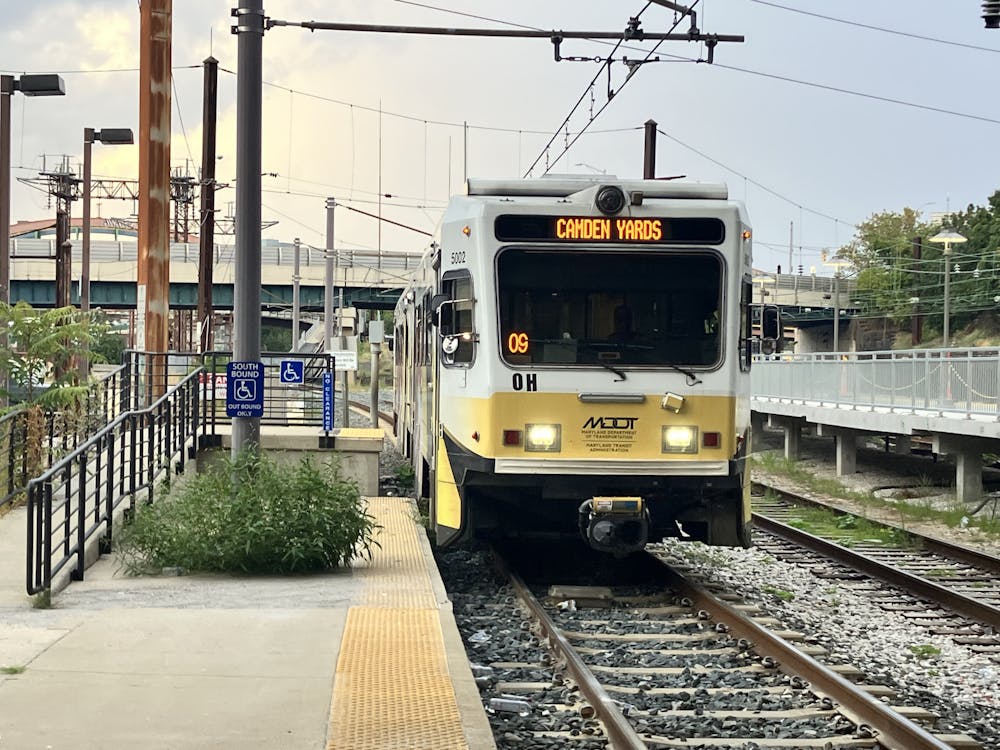
Baltimore isn’t completely devoid of rail transit – many Baltimoreans rely on the city’s subway system and light rail network to commute. The Baltimore Light RailLink is a light rail system (a smaller, more condensed subway system that often runs on the street) that carries users to Hunt Valley, Glen Burnie, north Baltimore City or the Baltimore/Washington International Thurgood Marshall Airport (Pro tip: taking the light rail to the airport is much easier and cheaper than taking an Uber or a commuter train). However, the closest stop to Homewood Campus is the North Avenue station, which is over a mile away, so it isn’t the best option for most Hopkins students. For Peabody students, the light rail is much more convenient, since the Mount Vernon station on the light rail is very close to Peabody. I have only needed to use the light rail once, when I needed to get from the convention center in the Inner Harbor to Hampden. Even so, from my experience, it was a pleasant ride, and the train came on time.
The Baltimore Metro SubwayLink is the city’s sole subway route, running underground through most of downtown Baltimore. The line’s terminus is at the Hopkins Hospital, which is convenient for those who frequent the Medical Campus; however, it runs even further away from Homewood campus. Unfortunately, I have never had the pleasure of using it, though I hope to in the future.
Method 3: Commuter rail and Washington Metro
With Washington D.C. only around 40 miles away from Baltimore, you would be remiss not to check out our nation’s capital as you’re getting adjusted to campus life. The Maryland Area Regional Commuter (MARC) Train is the Baltimore-Washington area’s commuter rail system. You can catch the MARC train from Baltimore’s Penn Station, which is easily accessed by Baltimore’s transit (or the JHMI), and ride the MARC train for about an hour to get to Washington D.C. Union Station, the last stop on the line. From there, you can transfer to the Washington Metro, which is a very reliable way to get around the city. At Union Station, you can transfer to the Red Line which can take you to attractions such as the White House and the National Mall.
Overall, Baltimore is not as daunting as it seems to get around by public transit. Whether you’re like me and refuse to get your license, or if you have to navigate life without a car for the first time ever, the city’s public transit options are always available, even if they’re not the most punctual. Getting outside of the ‘Hopkins bubble’ is very important for your enjoyment of the city. Whether you want to visit the National Aquarium, check out restaurants in Federal Hill or see our nation’s capital, know you don’t always have to get behind the wheel to do it.
Henry Serringer is a sophomore majoring in Writing Seminars from New York, N.Y. He is a News and Features Editor for The News-Letter.