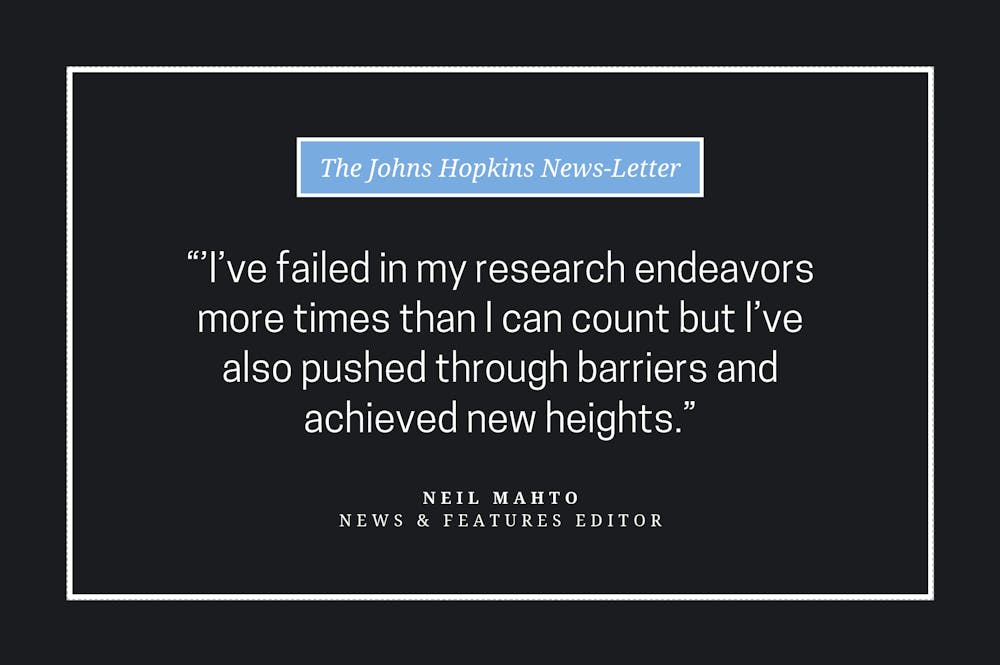
Hopkins is perhaps best renowned for its gargantuan research budget, topping the rankings of US institutions’ R&D budgets for 44 years straight and running. Many first-years might tell the reason they chose to come here was to participate in research, whether in Hopkins humanities, Applied Physics Lab, med campus or elsewhere. Yet, finding these opportunities can still feel very daunting for freshmen just arriving on campus. As someone interested in pursuing a career in biomedical sciences, finding the right research experience was very important to me. I’ve failed in my research endeavors more times than I can count but I’ve also pushed through barriers and achieved new heights. I hope that my experience can help guide incoming students to a smoother transition into a positive research experience.
Finding research groups
The University has many resources for finding research groups, many of which accept undergraduates. ForagerOne is a commonly used database to find which professors in your interests are taking students (however, the website is not always updated with the most current information on a given research group).
In my experience, going through a specific department and reading the biographies of individual faculty was most helpful in finding a research group. Remember that Homewood is just one part of university infrastructure that you can do research in — med campus, Applied Physics Lab, Data Science and AI institute and more all have research opportunities for undergraduates.
The cold email
The most obvious yet dreaded part of finding a research lab is certainly the cold email. Each year, first and second year undergraduates send dozens of emails to principal investigators (PIs) at Hopkins looking for research groups. This is a great way to put your best foot forward, but it must be done carefully.
In your email, you should describe your interests, your availability and predicted commitment, and a growth mindset. You should show professors that you will increasingly contribute to their lab’s work and take an active effort to learn and be mentored. My first emails spent too much page space focusing on my strengths and why I could contribute right away. The truth is you won’t be able to contribute right away. There is so much I didn’t know before stepping foot in the lab and it takes a couple months to learn enough to even begin making any sort of contribution to real discovery.
I would avoid mentioning goals such as publications or authorship. I made this mistake in many of my initial cold emails and it’s hard to know whether or not that was the reason I didn’t receive a response, but I feel confident in saying it didn’t help. Professors know that these are valuable CV lines. Rather, goals should be directed around discovery, growth as a scientist and improved critical thinking.
Introduce yourself, show that you’ve done your homework on the professor’s research and previous work, and how the two visions align.
First few months in the lab
Once you’ve found a lab, you might feel as if you’ve pushed the boulder up the hill. But, for students who seek optimal professional enrichment from their research experiences, finding a lab is the same as finding the boulder. The hard part remains to push it up the hill.
The best advice I can give to undergraduates in new labs is to read, read and read. Reading papers is one of the best ways you can learn about the specific field your lab works in and expand your understanding of methods and scientific directions. Further, communicate with your mentor to share where you’re feeling lost and what knowledge gaps you want to close. Your first few months in the lab will be a steep learning curve, but they are critical in ensuring you are able to pursue independence later.
Independent projects
If you stay in a lab long enough, you might have the opportunity to pursue your own project. There are many funding opportunities for independent undergraduate research projects through URSCA. There are also other foundations in Maryland that fund science research, such as The Maryland Stem Cell Foundation and Abell Foundation. For technical projects that require significant amounts of external funding, I would work with your PI to find grant opportunities or utilize lab resources.
The hardest part of independent projects is knowing what to do everyday. My suggestion is to create tentative plans, share them with your PI and ask for feedback. This keeps your PI in the loop of your contributions and keeps your science focused and grounded. It is very important to plan ahead and ask for help, from your PI, grad students or other professors, when you are pursuing independent investigations.
Summer internships
Not all labs at Hopkins can fund summer stays and not all students are able to achieve summer stay funding through programs like Summer PURA. That is absolutely okay: I myself have been rejected from PURA and other JHU URSCA awards multiple times but it hasn’t stopped me. Persistence will be one of your greatest attributes in pursuing research and at times, that is going to feel difficult. Finding a lab that you are passionate about and has a supportive mentorship environment can help ease that stress.
Perhaps, you are able to fund your own living expenses with an outside job, in which case, you should talk to your PI about your summer schedule honestly and maybe even inquire about doing research for credit. If you are not able to pursue summer research due to financial limitations, I would communicate this with your PI. If there are no viable solutions and you want to continue participating in research over the summer, internships are a great opportunity.
The National Institutes of Health Summer Internship Program, AMGEN Scholars and NSF REU programs are highly competitive, paid summer research experiences for undergraduates. Successful applicants typically already have high levels of research contribution. Other opportunities include but are not limited to Johns Hopkins Bloomberg Distinguished Professorship Summer Program, Stanford Summer Undergraduate Research Fellowship and U.S. Department of Energy Science Undergraduate Laboratory Internships. If you are someone who prefers to work in industry in the future, opportunities like Google Student Research internship for software, pharma company programs like Novartis’ Summer Biomedical Research Internship, and a summer at CERN for students interested in physics are better suited for your goals. I myself have no experience working in industry so I would recommend students do research on the differences between academic and industry research environments as they are significant. For industries and fields I wasn’t able to cover, I would recommend speaking with the JHU Life Design Lab about what opportunities are available for you.
You might get a co-author publication and poster presentation out of these short experiences, but the real value will come in the connections you build and experience working in a research environment.
Publications
Many Hopkins undergraduates come to campus or to undergraduate research with the goal of getting publications. Papers are certainly a valuable aspect of a student’s research record. However, as an undergraduate, publications should not and are not the end all be all of your future prospects.
Publications are merely a way to demonstrate that you have contributed to and independently performed scientific research as an undergraduate. There is no expectation by even the top graduate programs to have a first-author publication in Science Magazine. Your focus should be on learning the scientific process, collaborating with others and taking more initiative throughout your time in the lab.
Publications can come as a result of consistent commitment and contribution to a research group’s work. However, they are not the only way to demonstrate scientific impact and most students at even the top programs do not have first-author publications if any in peer-reviewed journals. These students, however, most likely did push themselves in research and go above and beyond their responsibilities in the lab. If you are committed, your contributions and effort will pay off when you apply to and interview for graduate programs or industry positions as your research experiences will supplement your resume, recommendation letters and demonstrated skills.
Conclusion
I remember when I first started this process, it felt like I was chasing the end of a rainbow. I can assure you that with enough patience and persistence, you will find a research position as a Hopkins student regardless of your previous experience or starting point. Finding the best one for you and putting your best foot forward will maximize your experience and the benefits you reap from it. Good luck!
(For students interested in biomedical research and wanting any more specific advice, feel free to reach me at nmahto1@jh.edu. For other student interests, I am also happy to connect you with peers in those fields.)
Neil Mahto is a junior from Albuquerque, N.M. He is a News and Features Editor for The News-Letter.