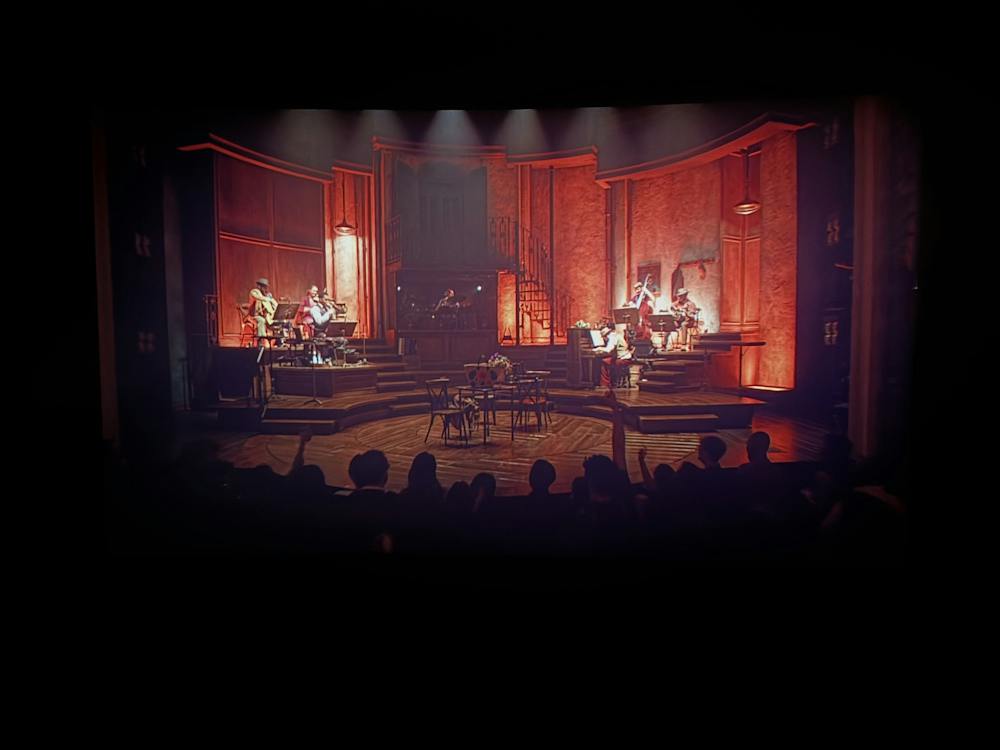
When I watched Hadestown live on Broadway in October of 2024, the tears started only one or two songs in. Objectively, there’s nothing sad about the beginning of the musical. Yet nothing moves me more absurdly than when Orpheus tells Eurydice, “I knew you before we met / And I don’t even know you yet.” My eyes well up with the special feeling of witnessing professional musical actors at their best. Sometimes, a song is so moving, so passionate, it feels like it could save the world — at least, that’s Hadestown’s central thesis.
On Monday, July 27 I watched the new stage film Hadestown (2026) at my local AMC. Written by Anaïs Mitchell and directed by Rachel Chavkin, the live musical Hadestown debuted on Broadway in 2019, starring Reeve Carney (Orpheus), Eva Noblezada (Eurydice), André De Shields (Hermes), Amber Gray (Persephone) and Patrick Page (Hades). The musical won eight Tony Awards and a Grammy for Best Musical Theater Album, and the stage film continued the success. In the opening weekend, Hadestown (2026) earned $10.2 million, breaking records for the highest-grossing live stage capture film. The film was slated to release for a limited five-day run from July 24–28, but the unexpected success prompted an extended theatrical release.
As one of those many theatergoers, I completely understand the excitement. When I saw Hadestown on Broadway, I didn’t catch the original cast, so their performances in the stage film blew me away. My sister joined me for both the Broadway show and the stage film, and we found Gray to be a real standout. Her acting and delivery, especially during the entr’acte “Our Lady of the Underground,” balances an endearing cleverness with a tragic desperation. De Shields, another one of my favorites, couldn’t have been a better narrator; his every gesture lands with authoritative gravity. We also loved the Fates, played by Bella Brown, Madeline Charlemagne and Allie Daniel. Their harmonization contributes to some of my favorite parts of the soundtrack in songs like “When the Chips are Down” and “Word to the Wise.”
Regarding the music, I’ve always appreciated how much attention Hadestown gives to its pit musicians, who are no less passionate than the musical actors and actresses. In the stage film, various angles shine a spotlight on those we don’t see as clearly, such as the drummer, Brad Webb, near the back of the stage.
In general, the stage film fully utilizes the switching of angles to compose really interesting shots. The look between Hades and Eurydice near the middle of the musical is breathtakingly tense, dramatically framed to make the confrontation more striking than if you saw it live on Broadway. More than any other scene, the shot of Orpheus in the dark during “Doubt Comes In” really highlights the advantages of the stage film format. Seeing the show live, you watch Orpheus walk in circles along the spinning stage, pretending to travel along the dark road out of Hadestown. In the film, space expands with the camera angles. Orpheus looks as though he is genuinely wandering in an endless dark expanse, with his face singularly illuminated and alone. Where, during the live show, I know that Eurydice and the other workers are following behind in the dark, the framing of the stage film excludes them and puts me into Orpheus’ unique perspective. There is an undeniable magic to live theater, but Hadestown (2026) takes full advantage of its form as a stage film to deliver a wholly new experience.
Hadestown (2026) joins the list of Orpheus and Eurydice film adaptations, alongside Orpheus (1950), Portrait of a Lady on Fire (2019) and La Chimera (2023). Like Alice Rohrwacher’s La Chimera, Hadestown blows the myth to massive, political proportions, using it to metaphorize alienation under capitalism and the disastrous effects of irresponsible energy production on the climate. While poignant, the use of ancient myth places the musical in a double bind.
Adaptations are tricky. While there’s a moving story to be found, the musical runs the risk of portraying systemic problems as interpersonal ones. In Hadestown, political action reduces to reminding Hades of his humanity and repairing Hades and Persephone’s love, which “made the world go ‘round.” All this takes is a special song, one which “brings the world back into tune,” by retelling the story of Hades and Persephone’s romance. It’s as if all the citizens and birds and critters in the kingdom live in harmony when the king and queen are in love. But is love enough?
Of course, Hadestown doesn’t hope to propose a guide to political action. Musicals, especially those with Greek gods, are not and do not claim to be real life. There’s importance in simplification, in abstraction and in fantasy. What Hadestown does hope for is for more hope. It’s not wrong to look at the past, at ancient myth, for hope in the future. Even if it's a sad song, there’s value in singing it again.