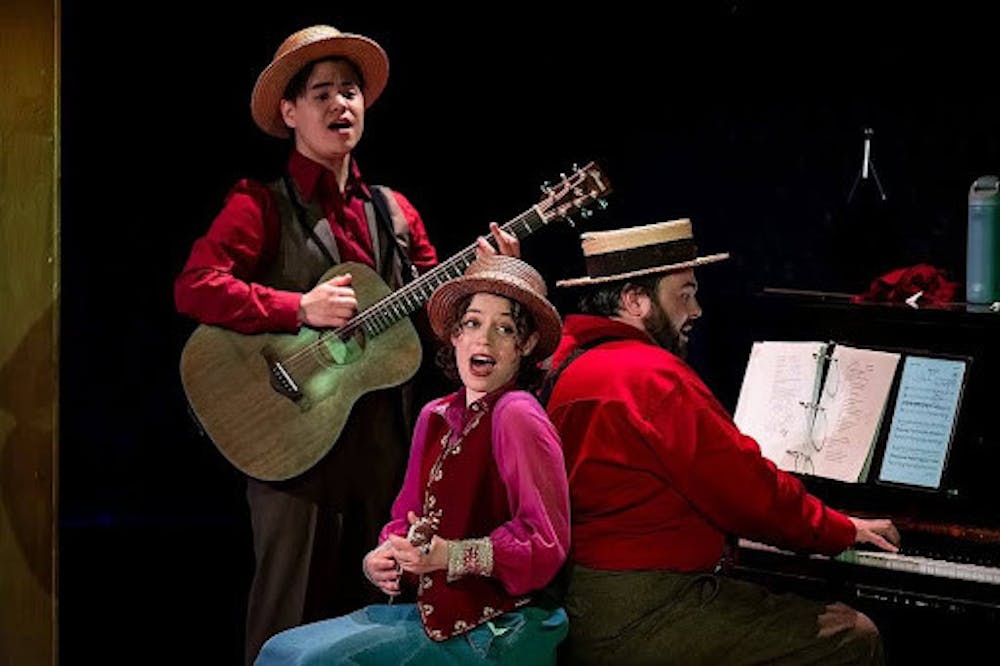
Back in April, I had the chance to see the opening show of Pericles. I have never seen a Shakespeare work portrayed through such a creative lens that kept the intent of the show intact. I always felt it was a tradeoff between keeping the plot and bringing a new perspective when it came to classic works. However, the Hopkins Theatre Department’s rendition of the show completely shattered that belief. Here’s some background about the show, from the original text to the department’s production decisions, that helped make the show work.
Pericles: What is it and why is it hardly produced?
It wasn’t until I heard that the Merrick Barn would be producing Pericles for the Spring Mainstage that I had even heard of the play. I decided to pick up the book from my local library and read it during winter break. This is when I realized there was one apparent theme that made the play difficult to produce: incest. Though only mentioned during Act I and the choruses, the incestous relationship between Antiochus and his daughter holds an irreparable value to the plot. I was hesitant to see how the Hopkins Theatre Department would handle the theme of incest, and as we moved through Act I, it became incredibly apparent that the cuts of the script were made with impeccable amounts of time and care to properly convey the stakes of shows in a mindful manner while concurrently leaning into the comedy of the script.
The Musical Heart: Tessa Barcelo and Max Hsu
The collaborative genius of Tessa Barcelo and Max Hsu truly brought Pericles to life, transforming the traditional John Gower narrator into a dynamic bluegrass and folk chorus. Hsu, a graduating senior in Writing Seminars and Political Science, brought a deep musical background, starting guitar at 10 years old and expanding to piano, bass, composition and songwriting. Barcelo, also a graduating Writing Seminars senior, started piano at five years old and added voice, drums, guitar, ukulele (which she played in the show) and bass.
The aesthetic direction for the music initially stemmed from the director’s specific vision of a bluegrass and folk-inspired chorus — referencing the distinct styles of Nat King Cole and Stubby Kaye (of Cat Ballou fame) — which created a unique framework for Hsu and Barcelo to inhabit. From this foundation, Hsu contributed his own diverse influences — namely the fingerstyle intricacies of Bert Jansch and Lindsey Buckingham, alongside a touch of Hadestown — while Ben Shaver, the music director of Pericles, introduced elements of vaudeville into the mix.
During the workshop phase of these songs, Hsu’s improvisation would usually take the lead while Barcelo joined in, with every session being taped so they could revisit those spontaneous moments later. Sometimes these vibes were more generalized — an upbeat and dramatic Chorus 1, for instance — while others were more unique and faceted, drawing inspiration from the epilogue of “Our Lady of the Underground” from Hadestown or the energy of Legally Blonde.
While Hsu noted that he and Shaver worked together quite effectively, the process wasn’t without its complications – particularly when it came to the immense pressure of navigating Shakespeare’s varied and often inconsistent meters in an email to The News-Letter.
“Some of the earlier choruses are in iambic tetrameter, mimicking the medieval style of John Gower, while others are in typical Shakespearean pentameter, and some aren't consistent at all,” wrote Hsu when discussing the challenges of the composition.
Barcelo also brought these choruses to life in her choreography and her interactions with Shaver, who played on stage in tandem with the duo. The trio found the inconsistent meter of Shakespeare's text challenging, especially in the choruses, but their smooth collaboration led to a unique, contemporary musical experience.
A behind-the-scenes look with Director James Glossman
I also had the privilege of being able to have a talkback over zoom with James Glossman, the director of Pericles. I used the interview to gain a further understanding of not only Glossman’s background in Shakespeare, but his vision for this production and the experiences that helped shape it.
Glossman studied performance of literature at Northwestern University before pursuing various advanced studies, including prestigious stints at the University of Oxford and the Yale Drama School. Following this training, he chose to pivot his talents away from acting to focus instead on writing and, more specifically, the art of adaptation, which he applied to works such as those of Raymond Chandler. He has primarily centered his work within the Mid-Atlantic area, having recently co-written a play with Tom Hanks titled This World of Tomorrow, that premiered off-Broadway this past October; it was John Astin, a longtime friend of Glossman, who eventually brought him to Hopkins during the 2000-2001 academic year.
Shakespeare has always been the singular playwright that Glossman found himself most passionate about, appearing to him as an “ever-changing and ever-working” entity that seemed to reveal more of its complexity the more he revisited it. Glossman explained that selecting Pericles for the Spring Mainstage felt like a natural choice, largely because the department maintains a specific dynamic of alternating the spring production between a smaller, intimate scale and a much larger, more expansive one. Since he had directed the play nearly 20 years ago, Glossman thought it was finally time to revisit the work to see what level of energy it could generate when student actors took on the roles and collaborated with him to create something new.
Glossman spent a significant amount of time studying the traveling theater cart and enjoyed the concept of having all actors, even Pericles, playing multiple roles. Although most of the casting was based on the actors’ abilities, the specific doubling of Antiochus and Lysimachus seemed to embody a clear moral spectrum (the “worst guy (Antiochus) and best guy (Lysimachus)”) necessary for the production. Mark Gonzales, a doctoral candidate in robotics, was his dream candidate for this specific doubling because of his kind character and his contribution to a collaborative environment.
Through these various means, most notably the musicalizing of the choruses, the play took on a contemporary dynamic. This is not the first time Glossman has musicalized a Shakespeare production. The last Shakespeare play he directed in the John Astin Theatre, Twelfth Night (not to be confused with the Barnstormers’ recent production of Twelfth Night in 2024), featured original music composed by Feste. As Glossman put it, “we showed people that the impact through musicalization in theater was how verse was to theater in Shakespeare’s time,” suggesting that the more we integrate music, the more engaging the theatrical experience becomes for a modern audience.
Glossman also used this opportunity to show off his world-premiere adaptation of Red Harvest, the Dashiell Hammett novel, being, of course, a lifelong fan of that hard-boiled crime fiction from the late 1920s. He described the story as being a morality tale in that old-school style of the private eye, essentially a question of how one might retain a moral compass when everything in the surrounding world has, quite frankly, “exploded and disappeared.” The world premiere play will be produced by the Hopkins Theatre Department as their Spring Mainstage for the 2026-2027 season.
Spotlights: what truly stood out
It’s undeniable that Pericles was a phenomenal success — but there were some moments in the show that have resonated with me even this long after the production. The fishermen scene in Act II, where fishermen in Pentapolis provide the shipwrecked Pericles with clothing to help him journey to King Simonides’ court, was so incredibly well done. The two fishermen, played by Yona Levine and Sara Pantoja, had an incredible chemistry with one another and had an even greater understanding of physical comedy. From playing with the fish prop to navigating how they moved about the stage, they kicked off Act II in a way that had the audience in the palm of their hand. Speaking of King Simondies, Jason Lafita had the audience in the palm of his hand in the interactions with himself, Pericles and Thaisa. He clearly highlighted the light-hearted, good nature of King Simondies, whilst simultaneously giving him a heightened energy that truly made the character his. He captivated the audience even in the smallest movement, such as his breaking of the fourth wall with incessant winking, capturing the overzealous plot that Shakepeare loves to write. In tandem with King Simondies, the three knights played by Kayla Sinkler, Gemma Watson and Sara Pantoja had an incredible sense of physicality that brought these smaller roles to life. They shuffled about the stage, played with the highly contrasting height dynamic, and used this scene for all it was worth. They didn’t need over-the-top movements to bring their roles to life; it was the small, cohesive movements they did that made their roles a powerful unit while still letting each of them shine.
In total, there were some groupings of actors that had impeccable chemistry and connection with one another that truly made the show feel real. One of these was Cleon and Dionyza, played by Cassandra Fan and Yona Levine, respectively. They both handled the text wonderfully, but what stood out was their connection. It was clear to anyone in the audience that they were incredibly connected to both the scene and one another, even when Cleon and Dionyza disagreed with one another. Another duo that were an incredible standout was Audrey Douglas as Pericles and Jewels Seeger as Helicanus. While the duo didn’t have the most time on stage together as these roles, every moment showed their connection. Additionally, the scenes where Helicanus was without Pericles and still declared their loyalty to the Prince showed the connection Douglas and Seeger had, both on and off the stage.
Vasilios Van de Verg as Cerimon truly captivated me as he excellently portrayed the older, over-the-top wiseman that keeps the plot going in circles. His interactions with Barcelo as she was in the box that was thrown out to sea was so excellently done. He truly kept us on our toes every time we traveled back to Ephesus, playing with the language of the script to bring his role to life. Watson was also a warrior when it came to wielding the text of Shakespeare. Each throwaway line was done with a calculated precision, and the lines that were meant to stick did just that.
Finally, I would like to highlight the title role of Pericles, played by Douglas. Pericles is an absolute beast of a role. From the amount of lines to the sheer intensity of transformation the character goes through as they age, Douglas knew the stakes for her character and truly showed it throughout the show. Even in the moments where her character was in his lowest parts, she never lost his intensity, leading us through this emotional journey in a way that was both incredibly riveting and convincing.
Concluding thoughts
Looking back, Glossman’s deep understanding of Shakespeare really shaped the whole experience into something phenomenal. You could feel how much freedom the actors had to bring their own vision to the stage. Every single person got their moment to shine before melting seamlessly back into the ensemble. The musical choruses gave the show such a fun, unique edge. The only con I had about the entire production was that the lyrics of the choruses were difficult to hear. Since I had the privilege of reading the text beforehand, I knew what was being explained, but to audience members that came in blind, it was difficult to follow along.
I remember laughing so hard at the blocking and choreographed scene changes. As soon as I’d caught my breath, something else would set me off again. Visually, it was stunning without trying too hard. The minimalist set and beautifully painted backdrop kept things clear, letting the breathtaking costumes stand out. Even with all the chaotic quick changes from actors playing multiple parts, every single look was impeccable. The cast and crew somehow managed to bring a traveling caravan right into Merrick Barn, making Pericles come to life.