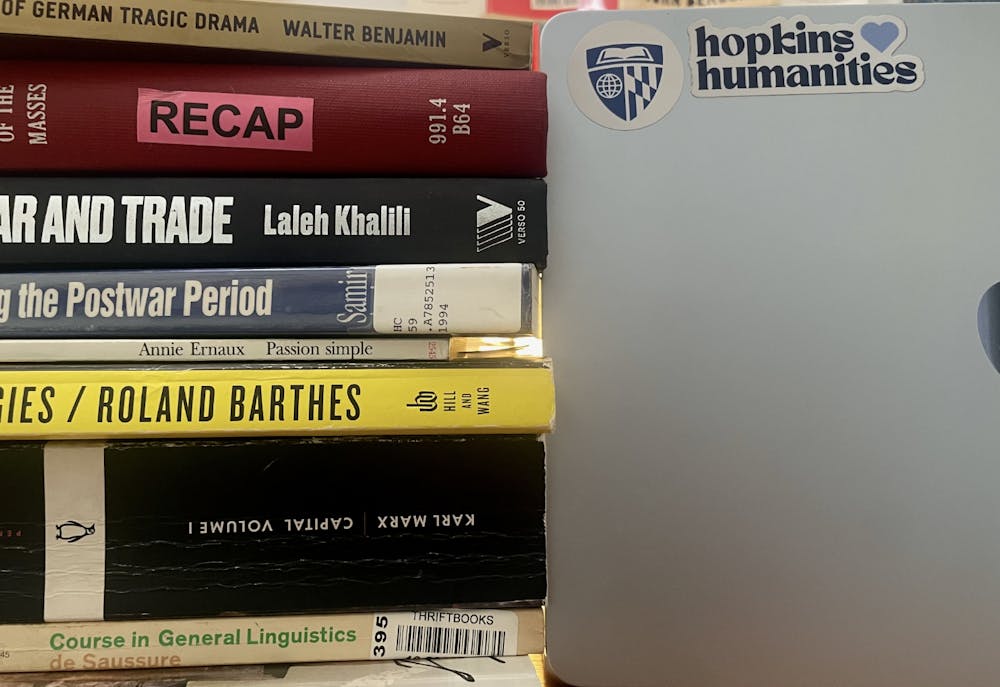
As a school full of pre-meds, we often think of the humanities as a welcoming refuge from frightening STEM classes. Yet while it’s true that anyone can participate in the humanities, it’s also true that the humanities are more than a dilettantish hobby to break from your STEM workload. As a pure humanities major at Hopkins, I’m a big believer that the humanities have their own depth and rigor in addition to their fun.
Of course, it’s no surprise that humanities classes have the reputation of being fun and accessible. Unlike with STEM majors, which typically follow a sequence of classes of increasing difficulty, humanities classes connect with each other in a less hierarchical web. With the lack of prerequisite classes, there’s a lot of room to choose, and you can more or less take courses of any difficulty in any order.
This isn’t to say that humanities course subjects are randomly scattered; rather than a vertical, sequential accumulation of knowledge in one direction, humanities courses offer an accumulation of knowledge in many directions, forming creative, horizontal connections.
Non-hierarchical structure also drives the seminar format common to humanities classes. Seminars put you in conversation with people from various majors and class years — my graduate student TA for a course this past fall became my classmate in the spring. This free, fluid structure makes the humanities really welcoming to anyone, from committed majors to people who haven’t picked up a book in a while.
However, you shouldn’t mistake the accessibility of the humanities for low-stakes ease. The amount of reading per week and the number of essays per semester are no joke, and, contrary to some expectations, an easy A isn’t guaranteed. I’ve had professors who give everyone an A and believe grades can’t measure how well you learn, but I’ve also had professors whip the class into a frenzy over a time-crunch blue-book final. I can’t speak to whether there’s grade inflation or deflation — that terminology seems to fit worse in the humanities, where grading is less a list of checked boxes and more in the subtle details. All I know is that it varies from professor to professor, and that a constant standard can only be set by you.
If you’re looking to raise that standard and really embrace the depths of the humanities, one of the best ways to dive deeper is with research. Humanities research is less standardized than a typical STEM experience with a lab and PIs. If you’re looking for a more collaborative research environment, many professors are open to taking research assistants during the summer, and some run lab-like projects where you can work with other students. For the most part, however, humanities opportunities are centered around individual research where you generate the topic, methodology and research timeline almost all by yourself. These include the Dean’s Undergraduate Research Awards (DURA), which allow students to work with primary resources from the Sheridan Library; the Women, Gender, and Sexuality department summer research grant; the annual Richard Macksey National Undergraduate Humanities Research Symposium, hosted by Hopkins; and the Pinkard Bolton summer internship, where students research the history of the Homewood Museum, among many more.
Hopkins is a research university, and our research culture of pursuing knowledge extends into the humanities as well. Are you ready to dive in? Maybe excited, maybe nervous? The ocean of the humanities is deeper than it might first appear, but you can’t learn how to swim without getting in the water.
Estelle Chen is a sophomore majoring in English and Philosophy from Columbia, Md. She is an Arts and Entertainment Editor for The News-Letter.