COURTESY OF JASON A. KONADU
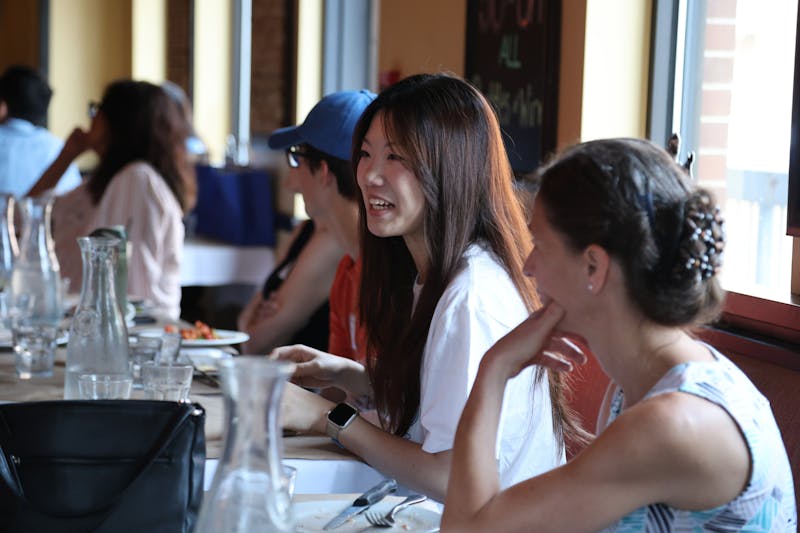
Huang reflects on discovering her changing passions in college.
COURTESY OF JASON A. KONADU
Huang reflects on discovering her changing passions in college.
When I came to Hopkins, I felt insecurity and fear of missing out. Like an alleged 70% of first-year students, I also circled “pre-med” on my questionnaire. I didn’t think there would be other paths for me. I was told at a very young age that the almost glorious and admirable occupation of becoming a doctor was the ending I was working toward.
The notion of change also intimidated me. I liked staying grounded in my comfort zone. I could only make progress step-by-step, with one thing naturally leading to the other, rather than wondering why I would even make the next step. I tried volunteering in the hospital, as the next “natural” thing I would do to achieve my “natural” goal of being a doctor. I counted my time minute by minute, wandered around the same hallway dozens of times and tried to do anything to fill up my two hours there. The nurse didn’t know what I was doing. Neither did I. I felt like a puppet hanging lifelessly by its strings. I dreaded the commute, the hours, the environment. So I thought to myself: Is this what you really want to do? To check off a box using hundreds of hours of your time that turns into a few lines of black ink on an application? Not really.
The environment I grew up in had made me hesitant and indecisive about the trajectory of my own life. I knew I didn’t like the menial work I was doing, but I kept going back again and again. Besides volunteering, I was constantly trying to plug myself into the latest Hopkins pre-med news, the tricks and strategies and the examples of what to do or what not to do. I became paranoid about my grades, overwhelmed by floods of emotions whenever I compared myself with the class average. These bad habits I had developed in high school persisted, and I didn’t know how to break from the negative cycles I was going through.
I was afraid of change. I was afraid of failing to become the successful prototype I was naturally meant to be. I was afraid to leave a path that so many of my friends and classmates seemed to be following. But what I really was afraid of was looking myself in the eye and confronting my feelings and emotions.
I needed to stop allowing this fixation to take away my sense of self, little by little. I didn’t know what I actually liked doing, so I started exploring. The explorations seemed aimless, but what they really did was allow me to learn what I value and what I do not. I went on a trip to New York City and visited investment banks and tech firms. Then I realized I really didn’t enjoy finance, but that’s okay! I dived deeper into research, and I enjoy research. I’m still doing community service in Baltimore because I love it and it means a lot to me, but I’m not doing anything that seems like I’m just loading up hours and wasting my time. I tried joining dance groups, even though I didn’t have any foundation. I joined a design team as an engineering novice, stumbling my way through the equipment and technical skills we used while learning how to listen to what people really need. While I’m still not entirely sure of what I want to be doing in five, 10, or 20 years, each of these experiences taught me something about myself.
An extraordinarily amazing, generous and kind mentor, Kareen from the First Generation, Limited-Income Network at the Center for Student Success, once led my group through a simple exercise. She asked us to write down in any format, even in your Notes app, what values you have relating to anything in this world. What environment do you want to work in? What parts of a location speak the most to you? What qualities do you want your friends to have, or how do you want to be treated and treat others? What do you not like when interacting with others? What type of work feels meaningful to you? What work does not? For 10 minutes, I thought deeply about my core values that should not be replaced by fame or prestige. And I encourage you to try this exercise too.
As you begin college, you might feel pressure to choose a major, career, friend group or version of yourself before you take the time to understand who you are. You might look around and assume that everyone else is so certain about their paths and directions. But you are allowed to pause and explore without knowing exactly what you want to do. You are allowed to think that something you once wanted no longer fits you. You are allowed to change directions. Be the owner of your life, because you’re the main character and the director.
Linda Huang is a junior from Rockville, Md. majoring in Biomedical Engineering. She is a Magazine Editor for The News-Letter.