COURTESY OF YUYU HUANG
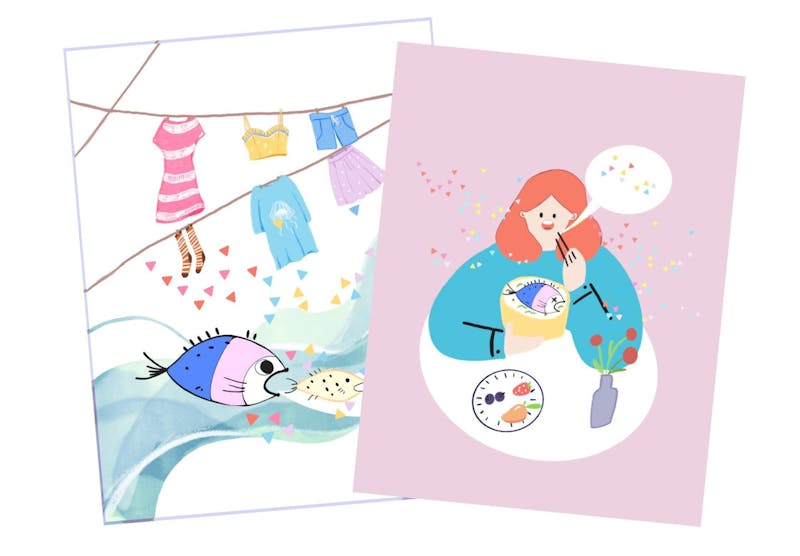
Huang stresses on the importance of hand-making a book and takes the audience on a journey of creation.
COURTESY OF YUYU HUANG
Huang stresses on the importance of hand-making a book and takes the audience on a journey of creation.
I often catch myself asking what I like, as the answers frequently change. Still, two things remain the constants of my life: drawing and writing. No matter how crowded life feels, they remain delightful retreats whenever I find a moment of leisure.
So when Dr. Benita Menezes, my Reintroduction to Writing professor, asked us to produce a “zine,” a self-published magazine that uses a collection of writing and graphics, to illustrate a theme we care about, I was excited: it was almost like creating a little book of my own. Dr. Menezes, who has created many books of her own, shared some experimental ways of designing a zine and conveying one’s thoughts that I found inspiring, and I hope to share a few of them with you.
Nonlinear brainstorming
In class, Dr. Menezes shared a very dynamic way to ideate, which is particularly useful when you already have an overarching concept for your project. You start by taking a piece of paper and folding it four times to create 16 rectangles (or however many feels feasible). Set a short timer — say, seven minutes — and try to fill the rectangles with as many doodles or stick figures as feel relevant to the theme. When time is up, you can draw lines to connect sketches that seem related; these connections may eventually surface as clusters or subtopics within your larger theme.
Shifting your point of view
Sometimes I feel dulled when I run into a rut of old writing habits, and I’ve found that broadening the genres of my source materials is a good way to break the cycle. While researching for my zine, Dr. Menezes asked us to draw references from four categories: scientific journals, social science articles, news reporting and personal narrative. We then selected two to three entries and wrote a brief abstract reflecting what we learned from each.
The freedom to use these “building blocks” is entirely in your hands — whether you choose to separate them into distinct sections or intertwine them like a collage. As you shift your points of view, or what Dr. Menezes dubs as different “vantage points,” you may discover new ways of portraying the same subject: seeing it through the lens of a scientist, an anthropologist or a storyteller. As you unlock different perspectives, you might find they piece together a more dimensional passage than any single viewpoint alone.
Writing between languages
If you’ve picked up more than one language over the course of your life, this can be an interesting technique to explore. Instead of doggedly writing every article in the language of your audience (likely English, given where we are), you could choose to sneak in a few sentences — or even entire pieces — in different languages within your book.
You could, of course, provide faithful translations to your audience, making the content fully legible. But you could also leave certain meaningful messages untranslated, giving a mythic space for readers to fumble with — or intuit — what they might mean. Another approach is offering only a concise translation that conveys the central idea while deliberately reserving the nuanced facets within the veils of the other language.
Here, I don’t mean to trip up your audience with word games, but to leverage the sophistication of languages. Since cultures influence the way we speak and feel, we often find words whose meanings are rooted in their particular cultural inheritances and are not fully convertible to other languages. So when we present the same idea in parallel, such subtle mismatches create a wondrous, ambiguous space. Whether you choose to clarify that space by approaching the closest possible translations or to leave it concealed within an unresolved curtain of myth, both paths may bring unanticipated inspiration for you as a writer — and a uniquely flavored experience for your readers.
I understand that we live in a time where things can be rapidly mass-manufactured, so hand-making a book may look inefficient and even meaningless. Yet the experience of building something tangible brings me some moments to cherish when I feel that my time seems to be on fast forward and the world spins. If you ever feel a similar way and want to create a vessel that can safeguard your thoughts in this efficiency-hyped world, feel free to use these approaches to build a book of your own.
Yuyu Huang is a senior majoring in Mathematics and Economics from Fuzhou, China. She is a Magazine Editor for The News-Letter.