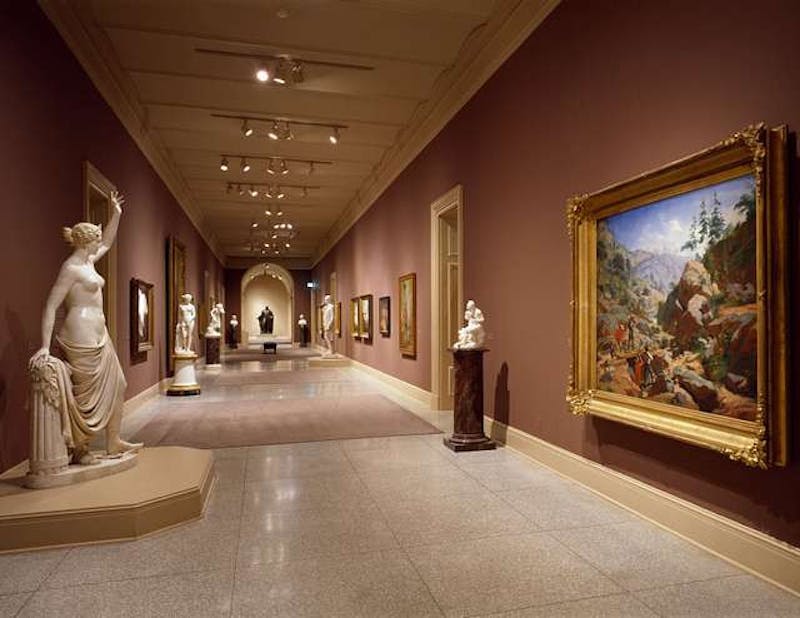
CAROL HIGHSMITH, LIBRARY OF CONGRESS COLLECTION / PUBLIC DOMAIN
Oh describes how she has grown more involved with museums.
CAROL HIGHSMITH, LIBRARY OF CONGRESS COLLECTION / PUBLIC DOMAIN
Oh describes how she has grown more involved with museums.
As always, I do like to start any guide-like article with a pretty pretentious disclaimer: rather than listing a set of universal rules, I’ll try to follow the words of James Joyce and offer my particular.
I grew up within an hour drive from the dazzling array of Smithsonian National Museums, which meant my primary and secondary education was speckled with annual field trips that aligned with the current curriculum. Unfortunately, most of my time in the museums was filled with mandatory worksheets. Despite the boredom, I still understood the combination of high ceilings and intentional lighting, and art — a word abstractive yet so directive — yields a vast, almost sacred space. It is sometimes easy to forget that they are built to be interacted with and that they are for the general public.
Only recently have I grown interested in museums as a space and a concept. Part of this change is due to reading Patrick Bringley’s excellent memoir, All the Beauty in the World: The Metropolitan Museum of Art and Me, which recounts his experiences as a museum guard. There are many people whose work goes into the daily operations of a museum: guards, curators, educators, conservators, outreach...
The labor along with the artwork itself, most of which aims to either capture or comment on a specific aspect of the human condition, characterizes an art museum to be in flux rather than a cold structure filled with delicate paintings and fragile frames. Although an anecdote with a sample size of one, if a museum is still so vibrant and ever-changing to an employee whose job is to keep an eye on it all day, then a one-day excursion cannot pass by without even a sliver of interest. Or at least I use that reasoning as an excuse to continue whenever entering a new, seemingly reserved art museum.
Even when examining art in genres I’m not particularly fond of, I am still able to cherish them due to another medium I adore: words. Artworks are not hung up by themselves. One form of education museums offer are the labels with the title and artist’s name that accompany each piece. When lucky, sentences explaining the historical context or artist’s intentions are included. I always enjoy interpreting the painting and noting its distinguishing features before turning to the label, especially when the label contains details that I’ve missed or, even better, completely flip my understanding on its head.
An especially wonderful museum I went to is the National Museum of Ancient Art at Corsini Palace. There, the labels completely elevated the experience by not being afraid to lean into abstractions and poetic language, directly engaging with the attendee by asking conceptual questions rather than simply being a compilation of relevant facts. And if the labels were so dynamic after it was translated to English, I can only imagine how intricate the nuances were in its original Italian.
Museums allow you to weave the past with the present: they might correct you or you might take what has been preserved and somehow twist it so it fits into your own life. But that isn’t to say that if you don’t, you’re going to a museum incorrectly. Whether your notebook is filled with references, events or figures by the end of the day or if you didn’t bring a notebook at all, whether you spend one minute or one hour in front of a piece, whether you read all the labels or skip over them, the museum will meet you where you are.
Grace Oh is a sophomore majoring in Molecular and Cellular Biology from McLean, Va. She is a Science & Technology Editor for The News-Letter.