COURTESY OF SAFFRON HALLETT
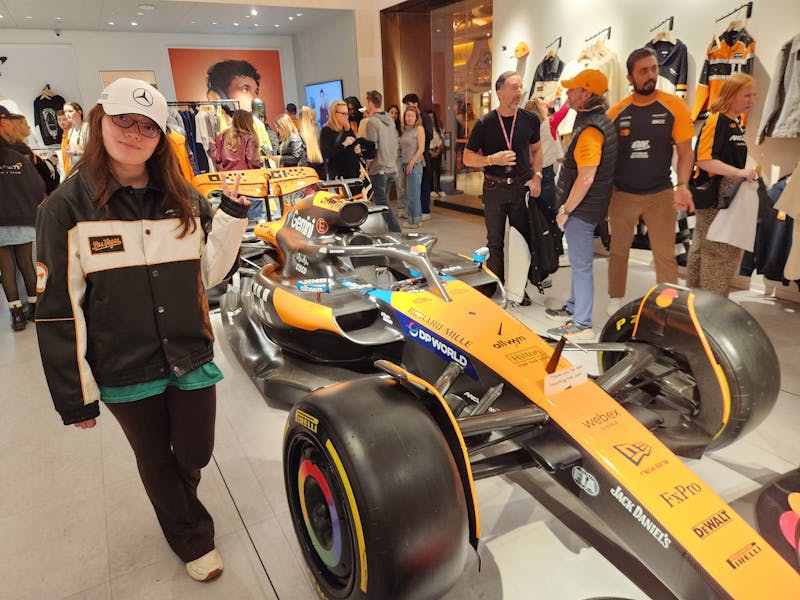
Hallett next to Lando Norris’s Mclaren F1 car at the Wynn in Las Vegas.
COURTESY OF SAFFRON HALLETT
Hallett next to Lando Norris’s Mclaren F1 car at the Wynn in Las Vegas.
Welcome to The Pinnacle of Motorsport! Since 1950, racing fans have tuned in to watch the fastest drivers in the world compete for the title of world champion. With races all around the world, ever-changing rules and regulations, up-and-coming talents beside returning veterans and more recently a box office hit, F1 is more popular than ever. But for those on the outside, it can seem daunting to get into. Let’s break it down!
The basics
This year, 22 drivers on 11 teams will compete in 24 races across 21 countries over nine months to determine who is the fastest driver (Drivers Championship) and which team has the fastest car (Constructors Championship) in the world.
A race weekend lasts three days, during which the teams have three free practice sessions (FP), which allows them to get a feel for the track, determine strategy and make last-minute adjustments to their cars.
This is followed by three qualifying sessions (Q1-Q3), where drivers are measured by their fastest lap of the circuit. These sessions determine the starting positions for all of the drivers for the race, and the driver with the fastest lap time earns the coveted “pole position.”
Finally, there is the Grand Prix itself and in 2026, six of the race weekends will feature a sprint race in addition. These shorter races do not require pit stops, and are often an all-out fight to the finish.
In a Grand Prix, the top 10 drivers score points with 25 from first, down to one for 10th. In sprint races, the top eight drivers score points, from eight down to one. Regardless of the type of race, the top three drivers stand on the podium, receive trophies and douse each other in champagne. At the end of the season, the driver with the most points is world champion. For the Constructors Championship, the points accumulated by both drivers of a team are added together to determine the winner.
Choosing a team
There is no shortage of teams to support! Ferrari carries historic prestige as the oldest team on the grid. McLaren won last year’s Drivers and Constructors championships. Red Bull and Mercedes are also strong contenders. Additionally, we have two new teams joining the grid this year: Audi and Cadillac.
Alternatively, many choose to support a driver (or even drivers). Some standouts are:
Lando Norris - current world champion, McLaren
Lewis Hamilton - seven-time world champion, Ferrari
Max Verstappen - four-time world champion, Red Bull
Ultimately, whether you choose to support a team or driver(s) is up to you. The easiest way to decide is to tune into the season as it kicks off on March 5 or watch previous seasons of Netflix behind-the-scenes documentary Drive to Survive (returning with the 2025 season on Feb. 27). Look below for more information.

COURTESY OF SAFFRON HALLETT
The starting lineup before Lights Out in Las Vegas.
First-steps itinerary
F1 kicks off at Melbourne's Albert Park Circuit in Australia, March 5-8! To enter the world of motorsport:
With that, it’s lights out and away we go!
Saffron Hallett is a freshman majoring in Writing Seminars and Psychology from Shelton, Conn.