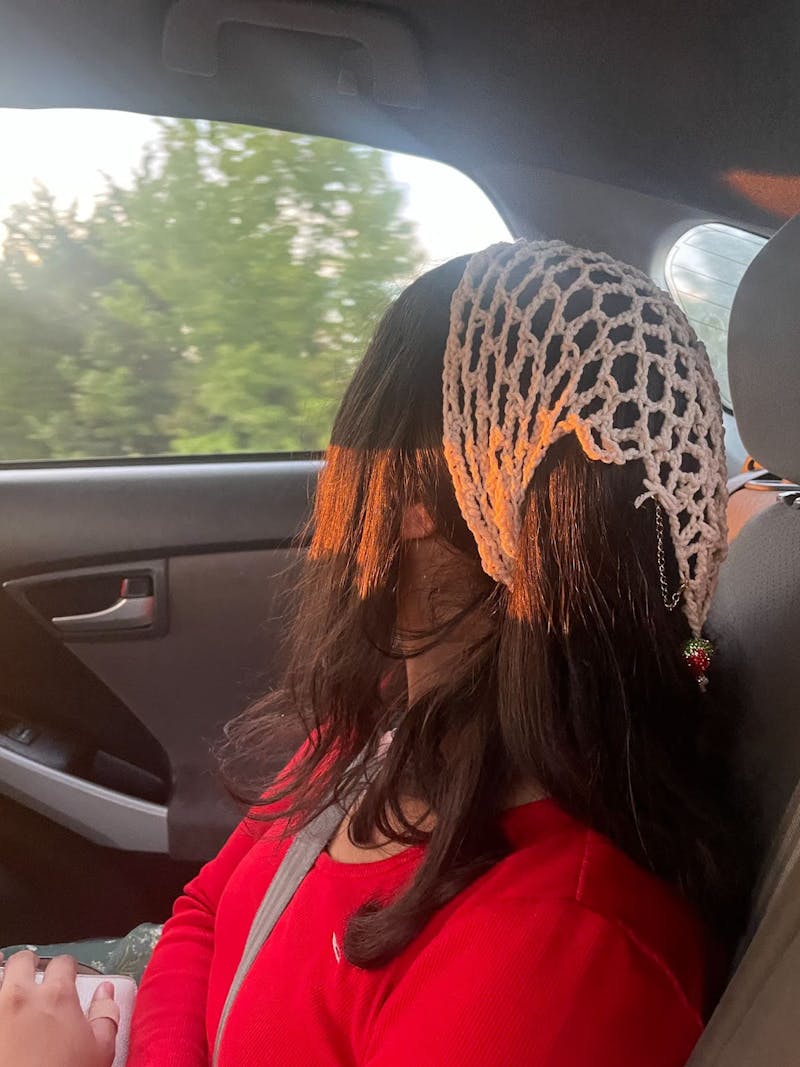
COURTESY OF SHREYA TIWARI
Tiwari discusses her on-and-off relationship with crochet.
COURTESY OF SHREYA TIWARI
Tiwari discusses her on-and-off relationship with crochet.
One morning, I woke up to find my phone charger unceremoniously tugged to the floor, in the space between my bed and the window ledge where it was originally placed. And as I did the usual awkward reach into that crevice, I realized that the loss of my phone and the subsequent back pain for its retrieval were punishment. The skein of baby pink yarn on that same ledge, studded with my 0.7 mm crochet hook, was tangled with my charging cable. My toxic situationship wanted attention, and it had decided that aggressively strangling my phone was the best way to receive it.
Crochet is the hobby I return to every time my life becomes even slightly complicated. I caught the “yarn bug” in response to severe exhaustion after sophomore year and peer pressure from my best friend. The first project I completed was that summer: a slightly anemic, messy pink heart that probably fell apart in a few hours (though I can’t be sure of this since I have no idea where it went). But progression was faster than I’d expected. My first “successful” project, completed just a few months later, was far more beautiful — a bandanna with gold chains and strawberry beads dangling from the edge.
Crochet has been my rock through heartbreak, an enabler for my severe procrastination on schoolwork and above all, the bane of my existence — a complexity I am perpetually shocked by because I love crochet. I love working with my hands instead of picking at my fingers. I love watching a row of stitches materialize, especially when I’ve managed to make the “inter-stitch” spaces perfectly even. I love when, after four or five rows, my somewhat more complete product resembles the video tutorial at which I’ve been intently squinting for hours.
But at the same time, there are few moments when I am more frustrated than mid-crochet project. Anyone who has dabbled in the craft knows the frustration of a dropped stitch or uneven yarn tension. Both casualties yield final products that are studded with holes and bumps, a fate that has befallen many of my earlier projects.
But my first successful project taught me the worst part of crochet: counting. Counting stitches and rows is the root of my commitment issues with crochet. Especially as a beginner, uneven edges and stitches in wrong orientations almost had me reconsidering multiple monumental life decisions, including being an engineering major. (Because how do I survive a field built on math if I can’t even tell the difference between the fifth and sixth stitch of the row?)
I am not beholden to or obligated to keep pursuing this somewhat torturous lover of mine. It indulges my unhealthiest tendencies. Crochet’s intricacies feed my anal-retentive perfectionism. It leaves marks on my skin in calluses and scars from working the yarn and the hook — a visible, painful, yet slightly discolored, sign of my hard work. It leaves a burning behind my eyes and blurs my vision; it leaves scars on my brain in the shape of the scraping of my metal hook against my fingernails.
Am I masochistic for it? Is it really so bad? To have scars and bruises that are not self-inflicted? To see evidence of my hard work within a few rows instead of on a midterm that is months later? To squint over stitches instead of books? Isn’t it worth it to have my brain hurt from piecing apart patterns instead of piecing apart a particularly frustrating problem set?
There is so much relief in putting all this effort into something that yields a product that feels so real, that leaves so much proof behind. So no matter how many times I reconsider my commitment, I will still return to my love. I’ll sit on the bed or in my living room and stitch and unstitch infinite swatches of yarn until black dots swim in my eyes. I’ll do the little awkward stretch to reach for my phone every time crochet rears its ugly head and feels abandoned for too long. We’re not breaking up quite yet.
Shreya Tiwari is a junior majoring in Biomedical Engineering from Austin, Texas. She is a Managing Editor for The News-Letter.