COURTESY OF JASON CHANG
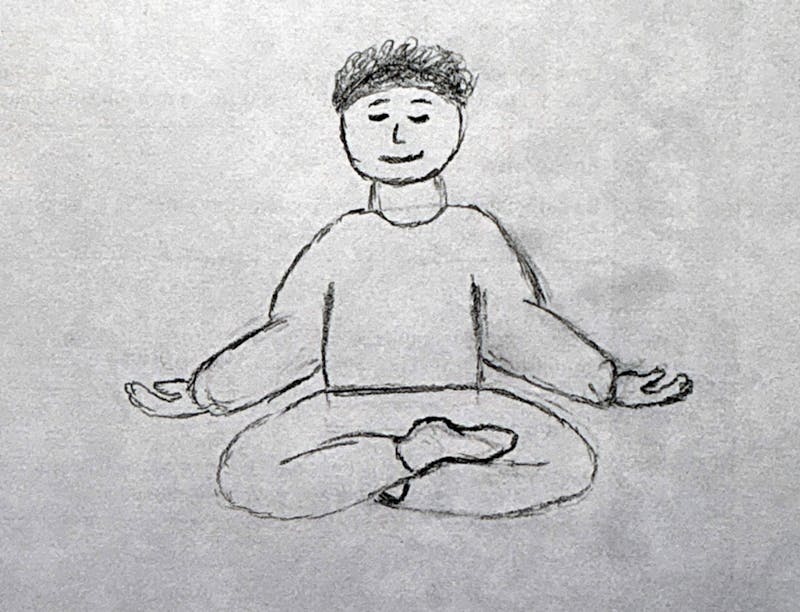
Chang reflects on the difficulty of meditation and how it helps him live in the present.
COURTESY OF JASON CHANG
Chang reflects on the difficulty of meditation and how it helps him live in the present.
Recently, I have taken up meditation. It is one of those things you turn to when you fall into a post-grad quarter-life crisis in your early twenties (you’ll know what I’m talking about when the time comes, trust me). I had hoped that always being told I am “mature for my age” would have saved me from such a fate, but alas, I succumbed to it alongside all of my friends once the summer after college graduation ended. Left with a choice between getting really into rock-climbing or trying to become an influencer, I decided to take the third option: turning to meditation and going on a quest to “find myself” instead. So starting this semester, I began a ritual of daily meditation, meditating for 15 minutes every day right after I wake up.
Surprisingly, my first attempt was easier than I thought. Concentrated on my breathing and determined to be mindful, the 15 minutes passed in the blink of an eye, the timer startling me as it went off unexpectedly soon. Yet counter-intuitively, it seemed to get harder with each passing day. After the novelty of the first time, familiarity with my newfound routine began to undermine me. With repetition, I found my brain drifting off more and more each day, now comfortable enough to switch into autopilot. My thoughts would wander, contemplating what I had to do for the day and planning out my schedule. Repeated attempts to gently guide it back to the task at hand only seemed to serve as a temporary solution before my mind wandered off once more. Even now, four weeks into my journey with meditation, I find it impossible to replicate the magic of that first time.
It seems ridiculous to me that meditating for a mere 15 minutes could prove to be so hard. After all, doing nothing should be the easiest task of all. But meditation isn’t just about passing the time. You can’t get anything out of it by simply investing the time; you have to be actively engaged in the practice. And while I’d like to think of myself as a disciplined person, meditation provided a different type of challenge. I couldn’t just brute force my way through sheer willpower like I could with running or working out, and I couldn’t outwork the problem or find special tricks like I could with school. All it asked of me was to be present. Yet somehow that seemed too much.
In an era that has conditioned our generation to expect constant stimulation, stillness feels impossible. In a society that idolizes efficiency, letting precious seconds drift by feels like a crime. Worst of all, sitting in my own chaotic and frightening head without distraction feels insurmountable.
But perhaps that is the whole point. As Marcus Aurelius points out in his conveniently titled work Meditations, “No retreat offers someone more quiet and relaxation than that into [your] own mind.” The sanctuary of our own thoughts is one we must occupy and coexist with for our entire lives. Thus, if we are able to turn it into a sanctuary, then we will have access to a retreat more precious and valuable than anything else. My hope is that through careful meditation, one day I can sort through the mess that comprises my inner landscape and turn it into a paradise into which I can retreat in my times of need.
Moreover, while time may be a valuable currency, time does not lend itself to being hoarded or micromanaged. Desperately clutching onto the seconds we have, white-knuckled, will do nothing to abate its flow through our fingers. It is the infinite paradox of life that we must realize our time is valuable, but we must not let that awareness drum us up into a panic, anxiously grasping at the fleeting sands of time, or else we shall lose the value of that time itself.
So while I have yet to attain an enlightenment to lift me out of my quarter-life crisis, I think I will keep at it in hopes of learning these lessons. And perhaps one day I can teach my brain to stop thinking about the future and the past and to simply exist in and appreciate the present.
Jason Chang is a first-year graduate student majoring in Chemical and Biomolecular Engineering from Woodbury, Minn.