COURTESY OF ALEX PAN
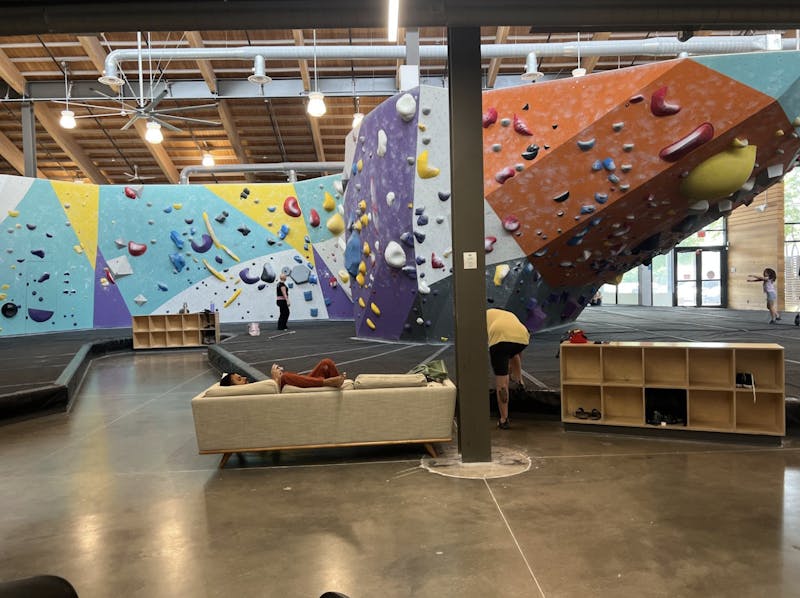
Pan describes his journey from discovering his side quest — rock climbing — to devoting his love and energy to it.
COURTESY OF ALEX PAN
Pan describes his journey from discovering his side quest — rock climbing — to devoting his love and energy to it.
Humans, and especially college students, love the idea of “optimizing” their time. We’ve all heard variations of these statements: How do I put in the least amount of work to get my intended result? How many hours should I spend on this activity to get to a specific level? What’s the latest I can start studying to still pass this exam? Will joining this fun club prevent me from doing my work?
Being at a university so focused on pre-professional development and career placements provides constant positive reinforcement for this mindset.
But we also do things just because we find them fun and personally enriching. These are our side quests. True side quests should be done for the love of the game, independent of any career goal (see “Your Second Greatest Love”). But even though they are done out of love, these quests should be treated just as seriously and with equal standards as a “main” quest. Here’s an example from my own life.
It started with a few innocent trips to the Hopkins Bouldering Cave with my roommates. Then I visited Movement Hampden for the first time. I stared in awe at the climbers projecting impossible V7–9 climbs while barely being able to make my way up the beginner V2 climbs. Then summer break hit, and I found myself with many more free afternoons. What better way to spend it than to purchase the rights to scale brightly colored plastic holds drilled into a plastic wall?
I started off with no qualms. But then I realized: wow — this is an expensive hobby. Not only is the gym membership $80 per month, but I also need to buy $200 climbing shoes, “premium” magnesium carbonate climbing chalk and an aesthetic bag to carry the “premium” chalk.
And there were the physical downsides too: a constant web of bruises and cuts on all 4 limbs, completely ground-down finger skin, excruciating torn calluses (flappers), soreness lasting weeks.
And not only that, there was an entirely new language I had to learn. The climbing gym was filled with people speaking in tongues. Over time, I slowly started picking up terms until that primordial alphabet soup congealed into understandable sentences. “Ah, so that’s what an arete is.” “Ohhh, that’s what a barndoor is.”
Soon, I started speaking the language myself. It goes a little something like this: “Traverse right to the crimp, then dyno to that nice hold (it’s a jug). After that, back flag to reach that pinch and match. Then make sure to do a drop knee before making that committing move, and then top out.”
Don’t forget the fact that I needed to allocate three hours of my day to climbing, which basically made it a part-time job.
Through all this physical, financial and linguistic pain, I continued. Why did I stay with something that hurt me and drained my summer internship stipend?
It’s that satisfaction I got from finally sending a hard climb or a hard move: slowly seeing the grades of my projects go up. It’s discovering the intricacies of balancing on slab climbs, making dynamic coordination moves and maintaining tension on overhang climbs. Though I don’t consider myself a “good” climber yet, I see myself getting stronger and climbing harder. And that constant visible improvement keeps me coming back.
I’ve learned that side quests shouldn’t be given up on a whim (unless I really hate it, then I guess I’ll give it up). Just because I failed to send any hard climbs today doesn’t mean I’ve lost my love for climbing itself. It feels good to improve at something, to get stronger at a set of skills you, sometimes arbitrarily, place value in. My climbing membership is $80 a month (please use my referral so I can get $25 off), but I still keep going because I believe the benefits I gain from climbing are worth that monetary value.
So even while pursuing side quests, you will fail. But these efforts are never wasted. They permeate your life and become a part of you. You find yourself growing passionate about your quests and sharing them with your friends. And though side quests may sometimes seem like irrational time sinks, if you truly love one, you will trust that it will continue to be rewarding even through all the failure and discomfort. Trust that it will make you a better person — a person with a couple more skills in their bag, more stories to tell and a new language to speak.
Everyone is just one person at the end of the day. We can only do so much with our time, so it seems tempting to put all our eggs in the career basket. But there’s so much more about life than just your career. So who knows, maybe your next chance encounter could turn into your lifelong side quest.
Alex Pan is a sophomore majoring in Molecular and Cellular Biology from Dallas, Texas. He is a Science & Technology Editor for The News-Letter.