COURTESY OF BUSE KOLDAS
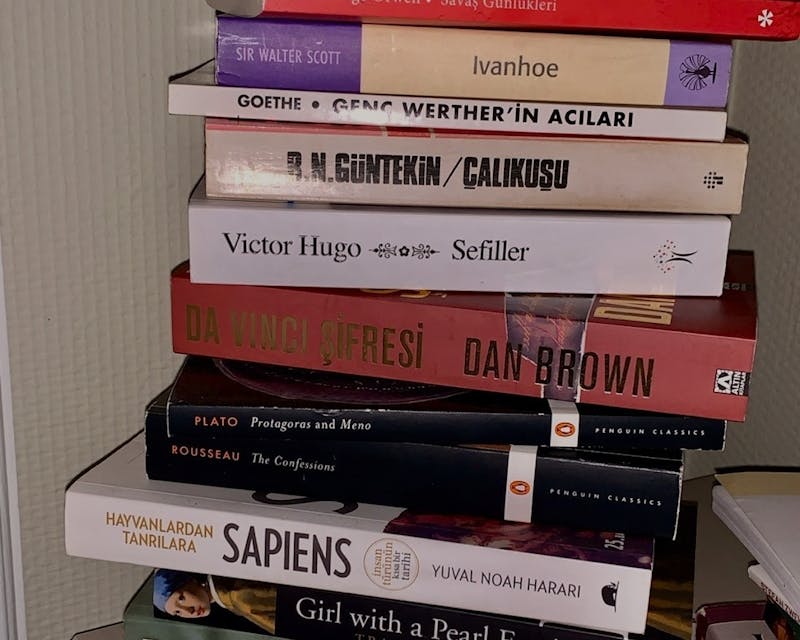
Koldas explains how she attempted to regain her reading habit over winter break.
COURTESY OF BUSE KOLDAS
Koldas explains how she attempted to regain her reading habit over winter break.
I constantly carry the guilt of not reading as much as I used to as a kid. I wonder where she is now (along with the red bendable book light my dad gifted me): the girl who would hide under her comforter so that she could binge-read the books of Ipek Ongun, Stefan Zweig, Resat Nuri Guntekin.
Obviously, this is not to say I haven’t read at all since my childhood; it just felt like I never read enough. The excitement of reading a book I like, being so captivated that it’s all I can think about, yapping about it to my friends and urging them to read it — these things never changed. I felt the same way about books at every age. In my experience, it even felt like a chain reaction: If I took the first step, simply opening the first page and reading the first sentence, the rest would follow, and my exhilaration would grow exponentially with every page I turned.
But somehow, as I grew older, taking that first step became more and more difficult, and I started reading less and less. When did reading start feeling like a chore rather than leisure? Was it when books started coming in the form of homework, something I was obligated to do? Or was it when the pressure of reading more “serious stuff” got more intense with every passing year?
Getting to the root of this problem took a reflection. I started comparing this phenomenon — which I named “The Struggle of Taking the First Step” — to other areas of my life. In what other parts of my routine do I struggle to start, but once I begin, the rest feels like a downward slope?
Here’s one example. The News-Letter general meetings are held on Mondays at 7 p.m., and although I love our paper, editors and “Gatehome” with all my heart, sometimes I dread leaving the comfort of my home. Pushing myself into the sweet chaos of running a paper — discussing the coverage of serious topics and managing people — is difficult to convince myself to do. But whenever I walk in and take my usual position to host the editors’ meeting, I remember why I do it every week. The work we do is stressful, frequently exhausting and requires sacrifice, but I love the end result: achieving something this big and continuing such a tradition alongside so many people surrounding me.
Reading a book feels similar. I know that it will become my next obsession if I manage to sit down and read the first page of Jane Eyre, My Year of Rest and Relaxation or Lord of the Flies. But, quite frankly, reading a book is stressful (What if I don’t like it and can’t finish it, or worse, don’t understand it?), frequently exhausting (as it feels much easier to open Netflix after 12 hours of productivity sucks the life out of me) and requires sacrifice (Should I prepare my cheat sheet for the Kinetics midterm or read one more chapter?).
This past winter break, the first day I checked my to-do list and saw no pressing items, I made it my mission to regain my reading habit and make my inner child feel fulfilled once again. In one month, I actually made decent progress: I finished Wuthering Heights, The Pilgrimage and The Count of Monte Cristo; I even started reading Don Quixote and The Gambler, although my reading consistency had to decrease with the start of a busy semester. During this journey, I came up with three key rules that helped me feel less intimidated by reading (and, more importantly, remain consistent with it).
I hope that the three rules I came up with for myself will either help you regain your reading habit or inspire you to come up with your own. Don’t let Hopkins make you feel like your brain is too fried to read for fun. Today, convince yourself to pick a book and open the first page.
Buse Koldas is a junior from Istanbul, Turkey majoring in Chemical and Biomolecular Engineering. She is an Editor-in-Chief for The News-Letter.